
Researchers at MIT World Peace University (MIT-WPU) Pune have developed a new protective enclosure for industrial abrasive saw machines. This innovative technology significantly reduces noise levels by up to 20 dB(A) while also containing sparks, dust, and flying debris, enhancing worker safety and welfare.
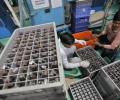
Escalating geopolitical tensions in West Asia are beginning to disrupt India's automotive supply chain, leading to rising commodity prices, logistics bottlenecks, material shortages, and pressure on consumer demand, with two-wheeler makers already raising prices.

Hyundai Motor India Ltd (HMIL) announced plans to make Tamil Nadu its 'flagship EV hub for India', committing over 26,000 crore in investment, enhancing localisation, and creating approximately 2,000 additional jobs over the next five to six years. The company will roll out two new EV models from its Chennai facility this year, including its first mass-market dedicated EV.

'Workers are being pushed into 12- to 14-hour shifts under poor conditions. These largely leaderless protests are likely to continue.'

Corporate India is projected to offer salary increments ranging from 8.6 per cent to 10.2 per cent across various industries in the financial year 2026-27, primarily fuelled by a sustained demand for skilled and execution-focused talent, according to a TeamLease Services report.

Tata Motors' commercial vehicle business is increasingly focusing on parts, services, connected-vehicle platforms, and digital businesses to drive growth and reduce dependence on cyclical vehicle sales, as outlined in its FY26 annual report.

A potential US-Iran peace deal, expected to be signed on June 19, is anticipated to ease geopolitical stress and benefit various sectors, particularly in India, with analysts suggesting investors await finer details before making significant moves.

'I own a few cars that I have had specified minutely to my taste, and it does feel nice to know that there are no other vehicles like them anywhere in the world.'
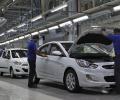
Rising automobile exports are reflective of the increasing acceptance of India-manufactured vehicles across global markets, according to Economic Survey 2025-26.

Workers at an automotive components factory in Haryana, India, protested for two days demanding the implementation of a minimum wage hike announced by the state government. The protests led to detentions and police action, highlighting tensions over wages and working conditions.

Domestic passenger vehicle dispatches in India surged by 27.3 per cent year-on-year to a record 4,38,854 units in May, driven by reduced GST rates and easier financing, according to the Society of Indian Automobile Manufacturers (SIAM).

Matter Motor's CEO discusses the increasing role of data and intelligent systems in the automotive industry, highlighting the shift towards software-defined mobility and AI-defined vehicles.
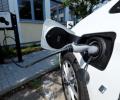
The Delhi government is set to equip its industrial training institutes (ITIs) with advanced labs to train young people in power electronics, electric vehicles, and the automotive sector, aiming to create a skilled workforce ready for industry demands.

While SUVs have steadily gained share across the industry, data shows that nearly three in 10 luxury vehicles sold in India are sedans, highlighting the segment's resilience despite years of SUV-led growth.

India's home-grown EV startups say the government's auto PLI scheme is helping big players while shutting out innovators building electric two- and three-wheelers from scratch.

American industry groups sought punitive tariffs on Indian goods at USTR hearings, while Indian officials defended the country's manufacturing growth as demand-led and WTO-compliant.

Passenger vehicle (PV) sales growth in India is expected to moderate to 3-5 per cent year-on-year (Y-o-Y) in financial year 2027 (FY27) due to a high base and preponed replacement demand, according to a report released by India Ratings and Research on Thursday.
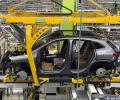
Domestic passenger vehicle dispatches in India rose 25.4 per cent year-on-year to 4,37,312 units in April, continuing the strong demand momentum from the previous fiscal year, according to SIAM.
Delhi Police have arrested a 33-year-old man for allegedly manufacturing and storing counterfeit automobile parts and packaging materials in a godown in west Delhi.

Glimpses from Beijing's grand Auto China exhibition reveal the rapid evolution of electric, autonomous and futuristic mobility.

Mahindra & Mahindra Ltd reported a significant 48.5 per cent jump in consolidated profit after tax to Rs 5,259.91 crore in the March quarter, primarily attributed to strong performance in its auto and farm sectors, alongside ambitious plans for new SUV and EV launches.
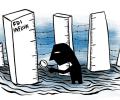
India's foreign direct investment (FDI) inflows are projected to surpass $90 billion in 2025-26 (FY26), driven by robust policy reforms, free trade agreements, and strong economic growth, according to DPIIT Secretary Amardeep Singh Bhatia.

Bajaj Auto is set to launch new Pulsar motorcycles in the 125cc and 150-250cc segments in Q2 FY27, aiming to capitalise on the upcoming festival season surge. This move follows strong growth in the 150cc-plus segment, where refreshed Pulsar models already account for over 50 per cent of Bajaj's sales.

As industrial plants boost the village's profile, locals demand priority hiring, alongside better storage facilities and water security.

Indian IT services companies are set to significantly increase their acquisition spending to $6.5-7 billion this year, up from $5 billion last year, as they seek to boost revenue and capabilities in areas like Cloud, data, enterprise platforms, and AI amidst a challenging economic environment.

India's electric motorcycle market is experiencing significant growth, with a 28 per cent year-on-year increase in volumes, as new product launches and improved total cost of ownership attract a broader base of riders beyond early adopters.
Indian carmakers experienced a robust start to the new fiscal year, with an estimated 4.5 lakh passenger vehicles sold in April, marking a 27 per cent increase year-on-year, attributed to factors like GST 2.0, repo rate cuts, and income tax benefits.

Karan Adani of Adani Ports & Special Economic Zone emerged as the top absolute value creator, adding Rs 2.67 trillion as the company's mcap rose from Rs 42,149 crore in March 2020 to Rs 3.09 trillion in March 2026 (7.3x) -- the largest rupee addition on the list.

After a record-breaking year, India's automobile industry is entering 2026 on a relatively strong footing, with sales growth expected in the 6-8 per cent range. The outlook is underpinned by policy support, including GST rationalisation, easing monetary conditions, and income tax relief, which together are likely to improve affordability and sustain consumer demand across vehicle segments.

Prime Minister Narendra Modi is set to inaugurate a semiconductor plant in Sanand, Gujarat, and launch multiple development projects worth over Rs 20,000 crore, marking a significant boost to India's semiconductor industry and infrastructure.

Jindal Steel has successfully deployed syngas in its galvanising and colour coating line furnaces to combat shortages of natural gas, LPG, and propane. This innovative approach allows the company to sustain operations and promotes energy self-reliance.

'In India's competitive automotive market, staying relevant means continuously raising the bar.'

S&P Global Ratings warns that a sustained rise in crude oil prices to $130 per barrel could significantly slow India's economic growth, weaken fiscal metrics, and strain corporate and banking sector performance, potentially reducing growth by up to 80 basis points.

The Indian government has waived customs duty on critical petrochemical products until June 30 to ensure supply stability and provide relief to consumers amid disruptions caused by the crisis in West Asia.
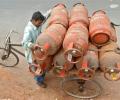
Researchers at CSIR-NCL have developed a technology for producing dimethyl ether (DME) as an alternative to liquefied petroleum gas (LPG), potentially reducing India's reliance on imports and enhancing energy security.
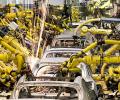
Passenger vehicle sales in India reached a record high of 4.7 million units in FY26, boosted by strong performances from major automakers and the implementation of GST 2.0.

Accel and Google's AI Futures Fund have announced the five startups selected for the 2026 Atoms AI Cohort, focusing on enterprise, voice, and industrial AI solutions, with each startup receiving significant investment and resources.

India's Sports Minister Mansukh Mandaviya is pushing to revive Formula One racing in the country, focusing on creating a strong pipeline of drivers and technicians. Discussions with the Federation of Motor Sports Clubs of India (FMSCI) have centered on developing a comprehensive framework to integrate motorsports with India's automotive and engineering sectors.

Speculation about rising competition from global majors has led to shares of major Indian automobile manufacturers such as Mahindra & Mahindra (M&M), Maruti Suzuki India, and Tata Motors taking a hit on the BSE.

Hiring demand strongest in ecommerce, tech startups, healthcare, and energy sectors, with Bengaluru, Hyderabad, and Pune leading.
